The Requests That Get Approved Are the Ones That Come With Proof
Budget season has a way of exposing how well a contact center can explain itself. Leaders who have spent all year managing volume, turnover, and service level suddenly have to translate that work into a case for headcount, tools, or training. And the people approving the budget are usually not the ones who live in the queue every day.
That is where many requests stall. Not because the need is not real, but because the case is built on experience and instinct rather than evidence. “We are stretched thin” is true in almost every contact center. It is also easy to set aside when every department is asking for more.
Why Contact Center Budget Requests Get Cut
Finance and executive teams look for three things in any request: what the problem costs today, what the investment will change, and how anyone will know it worked. Contact center requests often cover the first point loosely and skip the other two entirely.
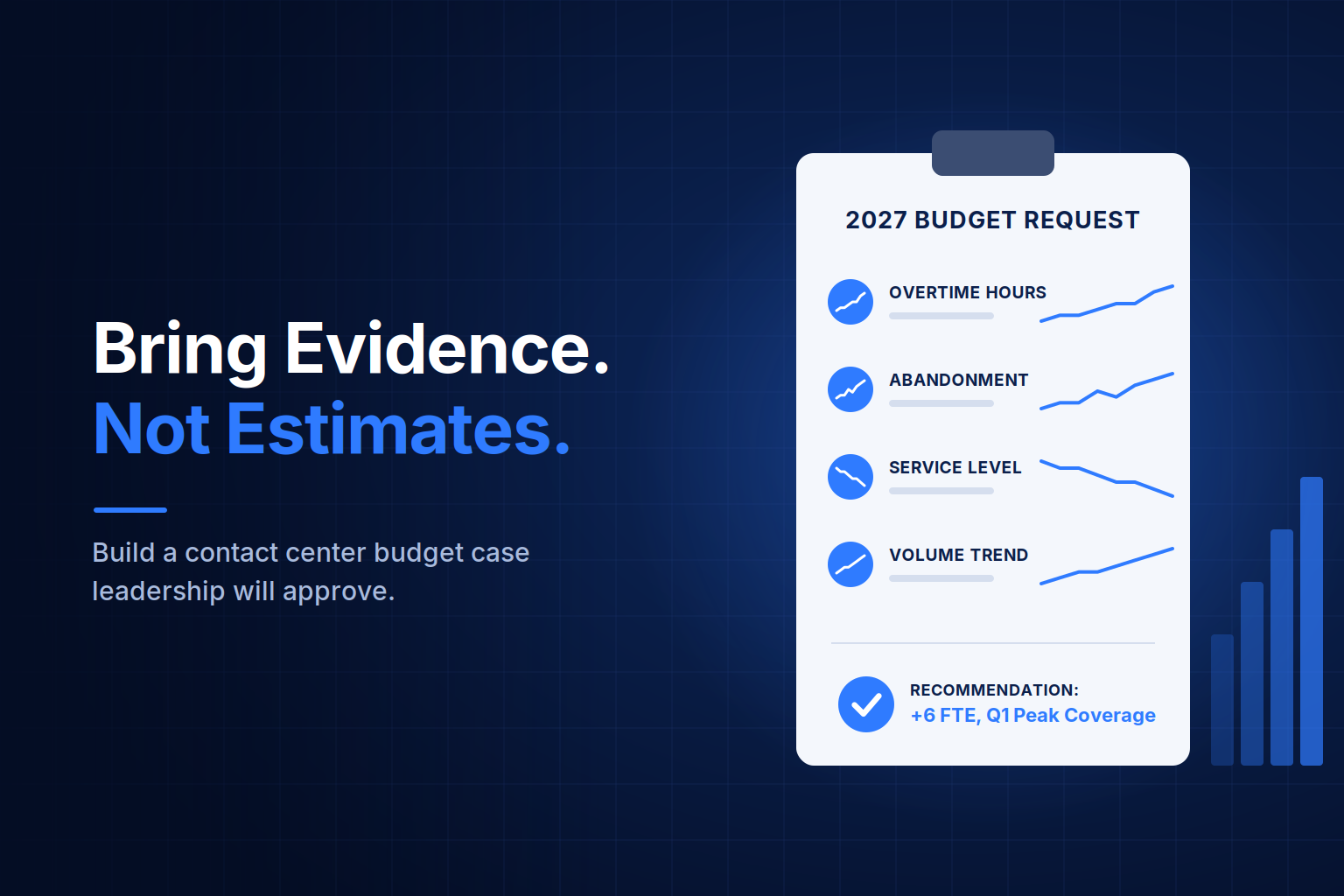
A request for five more agents that says customers are waiting too long is a complaint. A request that shows service level missed target in a specific share of intervals last year, that abandonment climbed in those same intervals, and that overtime hours grew each quarter is a business case. The difference is not the need. It is the evidence.
What Evidence to Gather Before You Ask
The Cost of the Current State
Start with what the problem is already costing. Overtime hours and trends. Abandoned contacts during peak periods. Repeat contacts that suggest issues are not getting resolved the first time. Transfers that add handle time without adding value. Each of these has a cost your organization is already paying, whether or not anyone has named it.
Trends, Not Snapshots
A single bad month is easy to dismiss as an outlier. Twelve months of data showing volume rising while staffing stays flat is much harder to argue with. Pull the trend lines for volume, handle time, and service level so the story is visible over time.
What Happened When You Had Enough
If there was a period last year when you were fully staffed, or when a process change reduced volume, compare it to the periods when you were not. Showing that service level recovered when coverage matched demand is some of the most persuasive evidence you can bring, because it came from your own operation.
How You Will Measure the Result
Tell leadership up front which metrics you expect to move and by roughly how much. Committing to a measurable outcome signals confidence, and it gives you a clear way to report back in the next budget cycle. We walked through how to frame that in How to Calculate the ROI of Contact Center Analytics.
How to Present It
Keep the ask focused. One or two well-supported requests will go further than a long list that dilutes attention. Lead with the business impact, then show the data behind it, then show the plan for measuring success.
Anticipate the questions. If finance asks why volume grew, have the contact driver breakdown ready. If they ask whether the problem could be solved with better scheduling instead of more people, show the interval data that answers it. A request that has already considered the obvious objections reads as a plan rather than a wish.
Frame the request around risk as well as opportunity. Leadership often responds more strongly to what happens if nothing changes: longer waits, higher attrition, and more pressure on the agents who are already carrying the load.
Frequently Asked Questions
What data do you need to justify a contact center budget request? At minimum, twelve months of volume, service level, handle time, and overtime trends. Abandonment and repeat contact data help show the cost of the current state.
How do you connect contact center metrics to financial impact? Start with costs that are already visible, like overtime hours and temporary staffing. Then connect service metrics to outcomes the business cares about, such as lost orders, missed appointments, or customer churn in your industry.
What if leadership does not trust contact center data? Use consistent definitions and a single source for every number in the presentation. If different reports have told leadership different things in the past, acknowledge it and explain which source you are using and why.
How can you build this case faster? The slowest part is usually getting the data. Brightmetrics gives contact center leaders self-service access to historical trends from Genesys Cloud, Mitel, and RingCentral, so building the case takes hours instead of weeks.
The Bottom Line
Budget decisions are made by people who have to choose between good requests. The contact center requests that win are the ones that make the choice easy: a clear problem, a clear cost, a clear plan, and a clear way to prove it worked.
The evidence is already in your platform. The work is getting it out in time to use it. Book a demo to see how Brightmetrics can help you walk into budget season with numbers instead of estimates.