Self‑Service Analytics: Getting Answers Without Adding to IT’s Plate
Why Ad‑Hoc Requests Pile Up
IT and analytics teams have real priorities: maintaining system reliability, managing integrations, ensuring security, and delivering strategic projects. Ad‑hoc reporting requests compete with all of that, and they usually lose.
When operational managers need quick answers, they are often asking for information that is not technically complex. Pull last week’s call volume by hour. Compare handle times across teams. Show abandonment rates for the past month. These are not difficult queries, but they still require someone’s time. That someone usually has a backlog of higher‑priority work.
The result is predictable. Requests sit in a queue. Answers arrive after the moment has passed. Managers make decisions without data or stop asking questions altogether.
But the initial wait is only part of the problem. What happens when the report arrives and raises more questions? A manager sees that handle times spiked last week, but now they need to know which team, which days, and which call types. That is another request, another explanation, and another wait. Each follow‑up restarts the cycle, and by the time you have drilled down to the actual root cause, days or weeks have passed. Sometimes the follow‑up data is not even available in a standard report format, so the trail goes cold entirely.
Meanwhile, IT spends cycles on work that does not require their expertise. Nobody wins. Managers do not get timely answers, IT gets pulled into low‑complexity requests, and the organization moves slower than it should.
What Happens When Managers Can Find Their Own Answers
Self‑service analytics shifts routine data exploration to the people who need it, freeing IT to focus on the work that actually requires their skills.
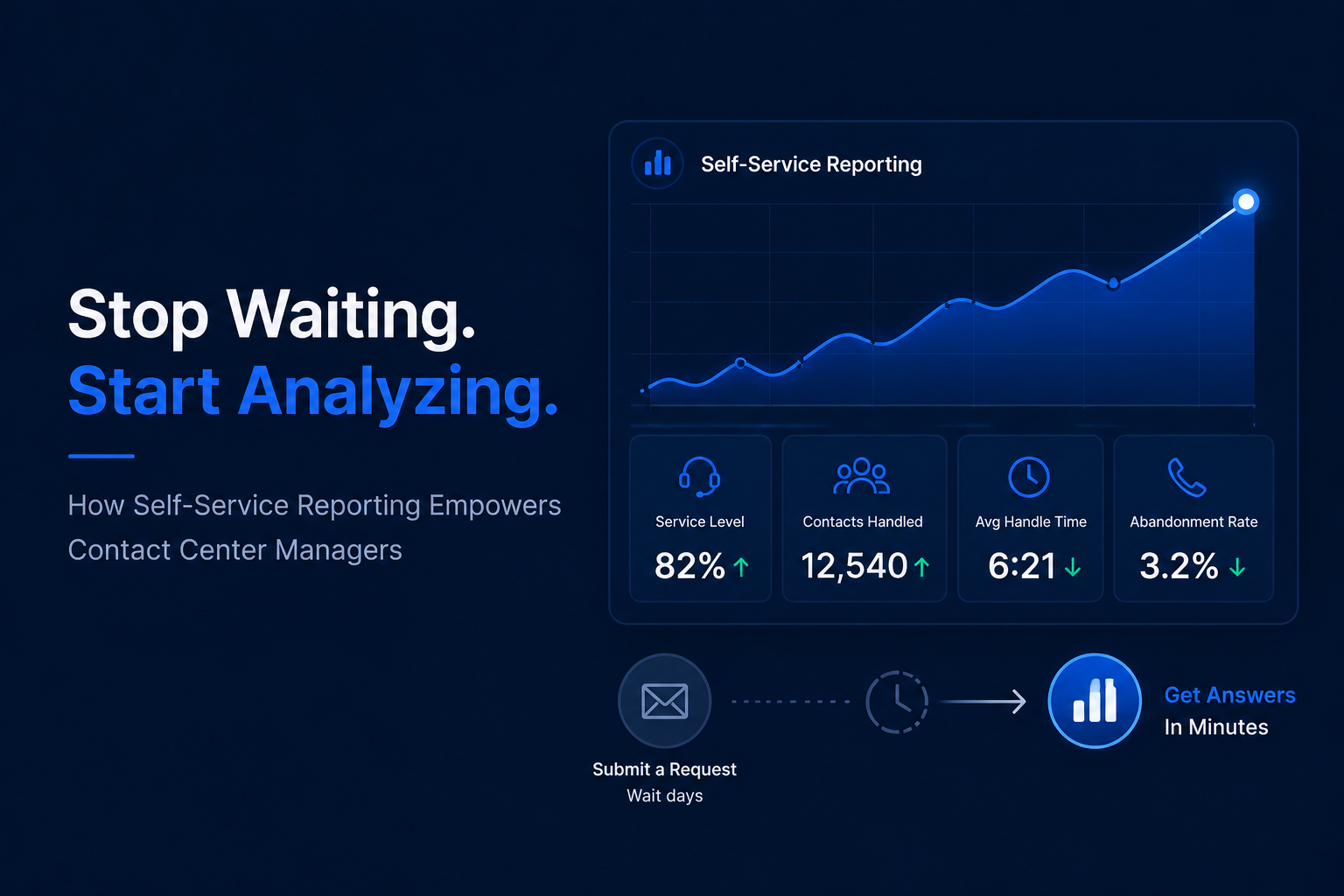
The most immediate benefit is speed. When a manager can pull up historical call volume and compare it to last week, they get an answer in minutes. Interventions happen while they still matter, and no one had to file a ticket.
Beyond speed, something else changes. More questions get explored. When data access is easy, managers start noticing patterns and testing hypotheses on their own. They catch issues earlier because curiosity does not require a formal request. A manager wondering why handle times spiked on Thursday can actually find out, rather than deciding it is not worth the hassle of asking.
Context improves too. No one understands what a manager needs better than the manager. When they can drill into the data themselves, they do not have to translate the question for someone else and hope the output matches what they meant. The person with the question controls the exploration.
For IT, self‑service is a relief, not a threat. Instead of fielding ad‑hoc queries, IT and analytics teams can concentrate on infrastructure, integrations, and complex analysis that genuinely requires their expertise. Self‑service does not diminish IT’s role. It lets them focus on the work they were hired to do.
Here is what this looks like in practice: a supervisor opens a dashboard, sees a metric that looks off, clicks into it, filters by team and time period, and identifies the root cause. When that first look raises another question, they drill deeper immediately. The entire investigation, from initial observation to actionable insight, happens in a single session. No ticket, no queue, no waiting for a follow‑up report that may or may not slice the data the way you need.
Making Self‑Service Work
Self‑service does not mean uncontrolled access to everything. Done well, it balances accessibility with appropriate governance.
Start with the Right Data
Focus on the operational metrics managers need most: call volumes, handle times, service level performance, agent performance, and key productivity indicators. Sensitive data stays appropriately controlled, and IT retains oversight of what is available and how it is accessed.
Choose the Right Tools
A static dashboard is not self‑service analytics. Real self‑service means users can filter, drill down, and slice the data in ways the original report builder did not anticipate. If managers can only view pre‑built reports, they will still end up asking IT for anything outside those boundaries.
Invest in Adoption
Self‑service tools only deliver value if people know how to use them. A little training drives adoption and reduces the temptation to fall back on “I will just ask IT.” Most managers pick it up quickly once they see how much faster they can get answers.
Trust Your Managers
Some organizations hesitate because they worry about data misinterpretation. But managers already make decisions every day. Giving them better, faster access to data reduces risk rather than creating it. Managers who understand their data make more informed decisions and feel more confident in their roles.
Shorter Path, Better Decisions
The goal is not to cut IT out. It is to make sure their time goes to the work that needs it most.
Tools like Brightmetrics make self‑service practical by letting managers drill into any metric, slice data by the dimensions that matter to them, and access historical trends without filing a request. When routine questions can be answered without IT involvement, everyone benefits: managers get faster answers, IT gets fewer interruptions, and the organization makes better decisions.
The best analytics investments are not the ones that produce more reports. They are the ones that put answers in the hands of the people who need them without adding to anyone else’s workload.