Leadership Does Not Approve Staffing Requests Based on How Busy It Feels
Every contact center manager has been in the position of knowing they need more coverage and struggling to get it approved.
The instinct is to describe how hard the team is working. How often the queues back up. How agents are stretched. That is all true and it matters. But it does not win budget conversations.
Leadership approves staffing requests when the data makes the case. When the connection between current staffing levels, operational performance, and business outcomes is visible and specific. When that connection is clear, the conversation shifts from “we need more people” to “here is what the current staffing gap is costing us and what the investment to fix it looks like.”
That is a fundamentally different conversation. One is a negotiation. The other is a presentation of evidence. And it requires data.
Why Most Managers Cannot Make the Case Cleanly
Most managers who struggle to win staffing requests have the right instincts but not the right data. They know the operation is understaffed. They cannot show it in a way that lands.
That usually comes down to access. When pulling 90 days of service level data by day and hour requires an IT request and two weeks of waiting, the staffing case either does not get built or gets built on incomplete information. The manager goes into the conversation underprepared, loses the ask, and continues operating understaffed for another quarter.
When managers can pull that data themselves in minutes, staffing cases get made more often, more specifically, and more successfully.
The Data That Makes a Staffing Case
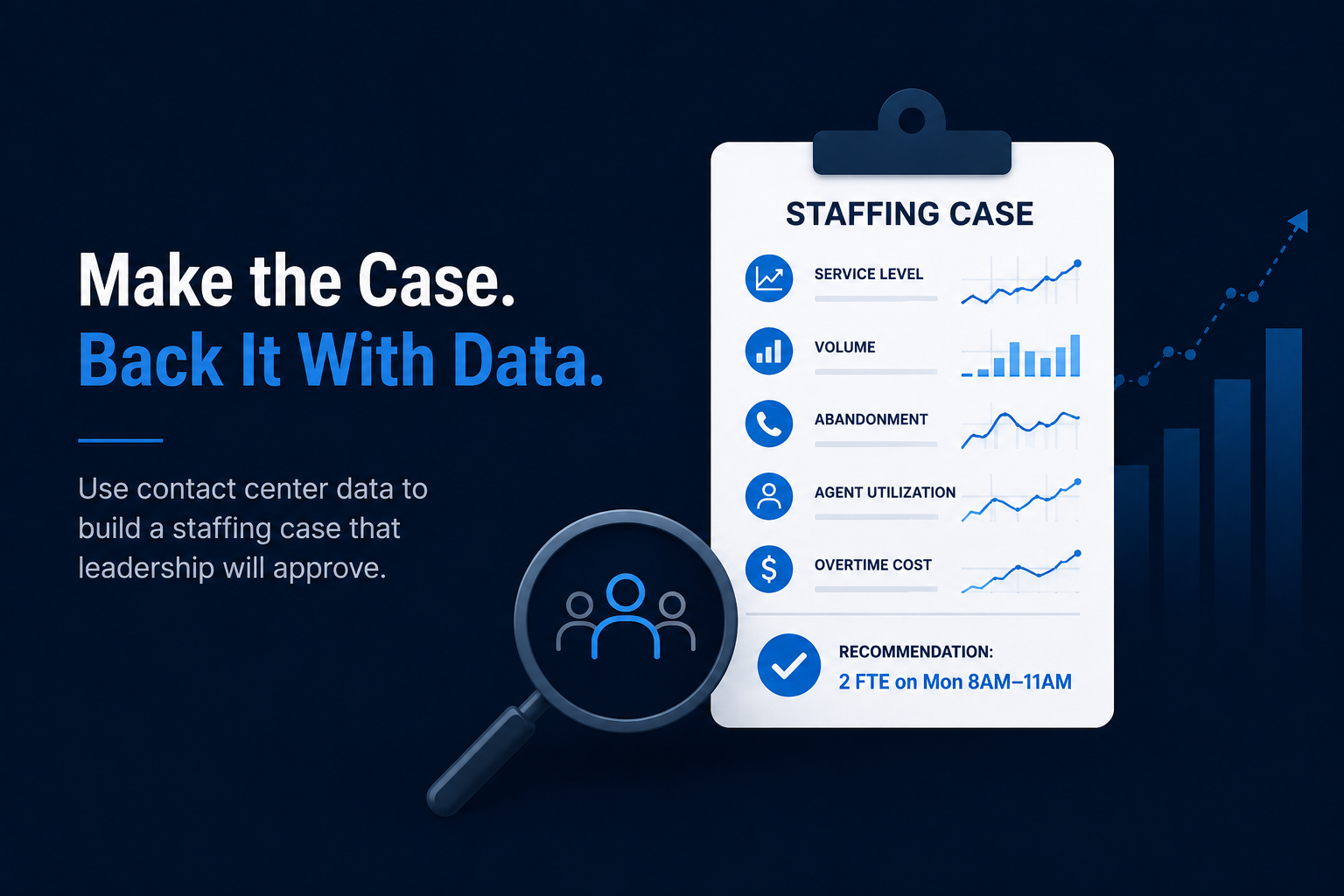
Service Level Against Target Over Time
If your service level target is 80 percent of calls answered within 20 seconds and you are consistently hitting 62 percent, that gap is the foundation of your case. Show the trend over 60 to 90 days. If it is stable at below target, that is a staffing baseline problem. If it is declining, the problem is getting worse.
The trend matters more than a single number. A snapshot can be explained away as a bad week. A 90-day trend is harder to dismiss.
Volume Patterns by Day and Hour
Show when the demand is highest and when coverage is thinnest. If volume peaks on Monday mornings between 8 and 11 AM and that is also when you have the fewest agents available, the staffing gap is visible and specific. Vague descriptions of being busy are replaced by a concrete picture of exactly where the operation is undersupported.
Abandonment Rate Correlation
When wait times climb because staffing is short, abandonment climbs with it. Each abandoned call is a customer who needed help and did not get it. In industries where that carries a revenue or retention cost, putting a number on it strengthens the case significantly.
Overtime and Agent Utilization Data
If agents are consistently running at 90 percent or above utilization, you are operating with no margin. If overtime costs are trending up as a result of chronic understaffing, those costs can often offset a significant portion of the cost of an additional hire.
How to Frame the Case
Show the Cost of the Status Quo, Not Just the Cost of the Fix
This is the most important framing shift most managers miss. Leadership is often focused on the cost of adding headcount. The more useful framing is the cost of not adding headcount: in overtime, in abandoned calls, in service level misses that have consequences, in agents who burn out and leave.
Connect the Gap to What Leadership Already Tracks
If your organization tracks customer satisfaction, show the correlation between service level performance and CSAT scores. If retention matters, show abandonment rate trends. If cost efficiency matters, show overtime spend. The more directly the contact center data connects to outcomes leadership already cares about, the stronger the case.
Propose Something Specific
A request for “more staff” is harder to approve than a request for two full-time agents on the Monday morning shift to address a documented 90-day service level gap on that shift. Specificity signals that you have done the analysis and know what you actually need.
What to Avoid
Using a single-week snapshot instead of a 90-day trend. Leadership will explain away a bad week. They cannot explain away three months of consistent performance below target.
Asking for headcount without specifying shift, queue, or gap. Vague requests invite vague answers.
Presenting data without connecting it to an outcome leadership tracks. Numbers without context are easy to set aside.
Walking in without a quantified cost of inaction. If you cannot name what the current situation is costing, the request stays abstract.
Frequently Asked Questions
What data do you need to make a contact center staffing case? Service level trends over 60 to 90 days, volume patterns by day and hour, abandonment rate, agent utilization, and overtime costs are the core data points. The goal is to show where the gap is, when it occurs, and what it is costing.
How do you quantify the cost of understaffing? Start with abandonment rate. Each abandoned call is a customer who did not get served. Overtime costs are directly quantifiable. Service level misses that carry contractual or compliance consequences often have the most compelling cost figures.
How far back should the trend data go? Sixty to ninety days is typically enough to establish a pattern. A year-over-year comparison for a seasonal peak strengthens a case for seasonal staffing investments.
Can Brightmetrics help build a staffing case? Directly. Brightmetrics lets managers pull service level trends, volume patterns, and abandonment data by any time period and drill into specific days, hours, and queues without waiting on IT or an analyst.
The Bottom Line
Staffing requests that come with data win more often than staffing requests that come with descriptions of how hard things have been.
The data you need exists in your contact center platform. The question is whether you can get to it quickly enough and in enough detail to make the case cleanly. When you can, the conversation with leadership changes from a negotiation to a presentation of evidence.