The Common Challenge Supervisors Face
Your contact center tracks everything. But data driven coaching in the contact center only works when supervisors can actually access and use that data. Handle times, call volumes, customer satisfaction scores, schedule adherence, and more. It is all in dashboards somewhere, gathering data.
But when you sit down to coach an agent, how often do you actually use it?
If you are like most supervisors, the honest answer is probably not that often. Coaching tends to happen based on what you remember, what you overheard, or whatever issue came up that morning. The data sits in one system. Your coaching conversations happen somewhere else.
That is a missed opportunity. When used correctly, data can make your coaching sharper, faster, and more effective. It can help you catch issues early and have conversations that actually stick. But it only works if you can access it easily and know how to use it.
Why Data Doesn’t Show Up in Most Coaching Conversations
There is a simple reason data stays out of coaching: it is too hard to get. Supervisors are busy. You handle escalations, answer questions, juggle schedules, and put out fires. Coaching gets squeezed into whatever time is left.
When you finally sit down with an agent, you are not going to spend 30 minutes pulling reports first. If the data is hard to reach, you skip it. You coach based on what you noticed or what you remember.
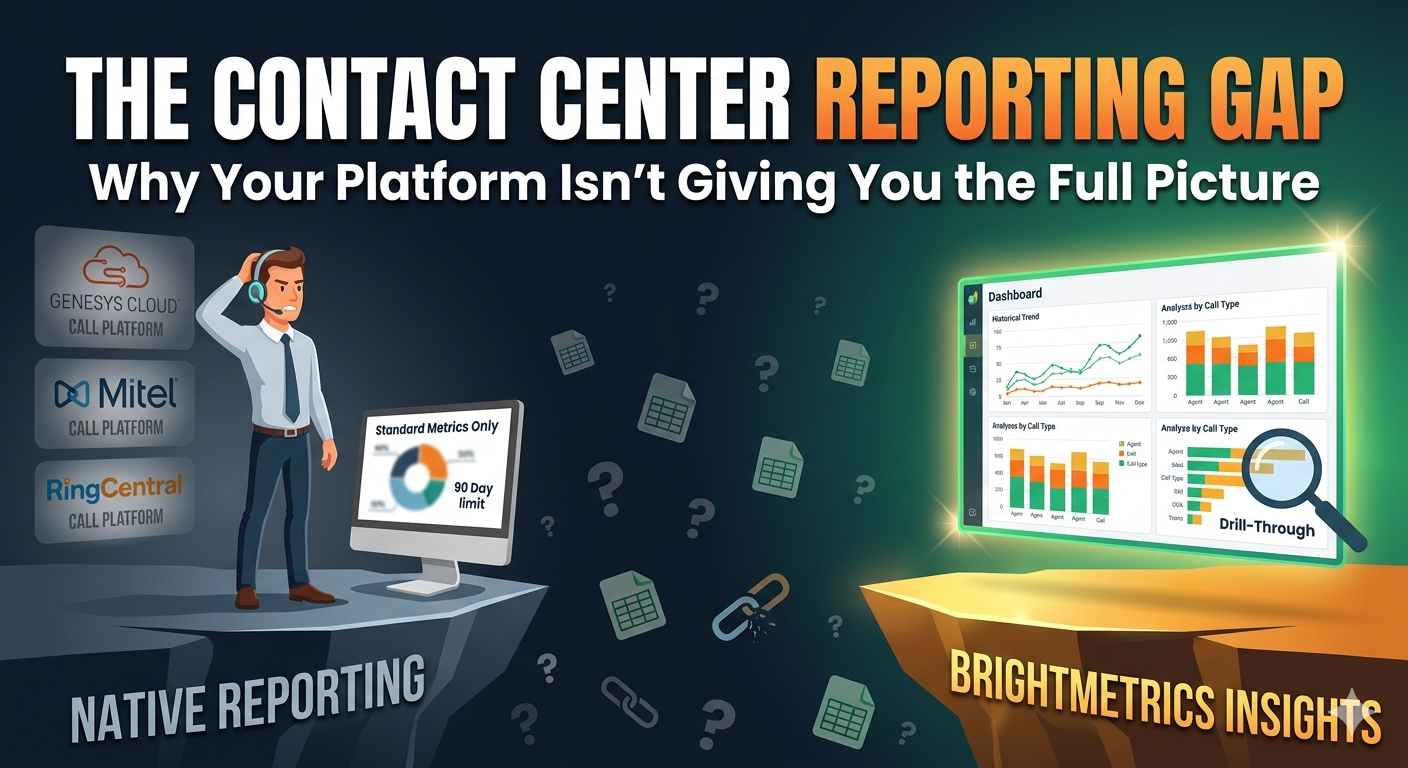
In many contact centers, getting a custom report means submitting a request to IT or an analyst. Then waiting. Then getting a report back that still does not answer your question. By the time that happens, the coaching moment has passed.
If this sounds familiar, the problem is not you. The problem is a system that makes data too hard to reach.
What Happens When You Coach Without Data
When data is hard to access, coaching suffers. It becomes inconsistent. You give feedback to whoever you happened to notice. You catch problems late, after they have already become patterns. Your feedback can feel like opinion instead of fact.
Meanwhile, you spend time chasing down information instead of talking to your team.
That pattern erodes trust and wastes time.
What Data Driven Coaching in the Contact Center Actually Looks Like
Now imagine the opposite.
You can pull your own reports. No tickets. No waiting. You log in, look at your team’s numbers, and see what is happening in just a few clicks.
When something looks off, you can dig into it. Filter by day, by call type, or by individual agent. Answer your own questions on the spot.
Your coaching conversations start with specifics. Instead of vague impressions, you say things like, “I noticed your wrap up time jumped on Wednesday. Walk me through what was happening then.”
That is a real conversation based on real patterns.
Agents trust feedback that is grounded in something real. They can see the same numbers you see. It is not a mystery. It is not surveillance. And it is not about catching people doing things wrong. It is about having visibility that helps you support improvement.
When data feels like a tool and not a weapon, coaching becomes collaborative instead of confrontational.
Get Yourself Self-Service Access to Performance Data
If you do not already have self-service access, get it. This is the foundation.
You need the ability to open performance data, drill into a specific metric, and slice the data however you need it, without filing a request and without waiting days.
Self-service does not mean drowning in data. It means having the right views: team performance, individual performance, trends over time, with the ability to dig deeper when something catches your eye.
If your current tools do not let you do this, talk to your manager or your IT team. Explain what you need and why. The goal is simple. You should be able to answer a performance question in a few minutes, not a few days.
Focus on Metrics You Can Actually Coach
Not every metric belongs in a coaching conversation.
Some are outcomes. Customer satisfaction, for example. You cannot tell someone to “be more satisfying.” It is the result of many factors.
Other metrics map directly to behaviors. Handle time breaks down into talk time, hold time, and wrap up. Each of those is something you can work on with an agent. You might say, “Let’s look at your hold time. What is causing you to put customers on hold so often?”
Focus on metrics you can influence. Keep the list short. Three to five core metrics is enough. When you know exactly what you are coaching to, your conversations become much sharper.
Build a Regular Coaching Rhythm
Data-driven coaching does not happen when you get around to it. It needs a rhythm.
That means regular one-on-ones. Weekly or every other week with each agent. Keep these sessions short, maybe 10 to 15 minutes. Focus on one or two things, not a laundry list.
Review the data before the conversation. Not during it, and not after. That way you walk in knowing what you want to talk about. A predictable rhythm does two things. It makes coaching a habit, and it sends a message to your agents that development is ongoing, not just something that happens when they mess up.
Use Data to Start the Conversation, Not End It
Having access to data is one thing. Knowing how to talk about it is another.
The key is curiosity, not accusation.
For example, asking “I noticed your hold time was higher last week. What was going on?” opens a dialogue. Saying “Your hold time is too high” tends to shut it down.
Data should start the conversation, not deliver the verdict. Your job as a coach is to ask questions, listen, and problem-solve together. Agents respond better when they are part of figuring out the solution, not just being told what they did wrong.
This takes practice, but it makes a big difference in how feedback lands.
Traps to Avoid
Metric Shaming
Using numbers to punish instead of develop. One conversation where data feels like a weapon and you risk losing trust. That trust is hard to rebuild.
Data Overload
Trying to cover 15 metrics in one conversation overwhelms. Pick one or two things to focus on.
Skipping Context
“Your AHT is high” is useless if you do not know why. Was it one bad day or a whole week? One call type or all of them? If you cannot drill into the details quickly, the conversation goes nowhere. The agent gets defensive. You cannot offer real help.
Inconsistency
If you only use data sometimes or only with some agents, people notice. It feels unfair. Use data consistently in every coaching conversation, not just when there is a problem.
Treating Data as the Whole Story
Numbers show what happened, but they do not always explain why. Always leave room for the agent’s perspective. Sometimes there is a good reason behind a number.
The Payoff
Data driven coaching in the contact center helps supervisors spend less time guessing and more time helping. Problems get caught early instead of becoming patterns. Agents trust your feedback because it is grounded in reality instead of opinion.
Getting there takes effort. Start with access. If you cannot easily get to performance data, push for tools that let you. Then pick your metrics, keep the list tight, and build a regular coaching rhythm with data reviewed before conversations.
Brightmetrics helps with this. It puts real reporting power in your hands without IT requests or waiting. You can drill into agent performance, see what is behind the numbers, and walk into coaching conversations ready.
Whatever tools you use, the principle holds true. When data is easy to access, coaching gets better. When it is locked away, coaching becomes inconsistent and less effective. Remove the friction. Your agents will benefit and your contact center performance will improve.