Everyone in the Contact Center Is Accountable. Far Fewer Have the Evidence.
Contact center leaders are held accountable for a lot. Service level, customer satisfaction, handle time, cost per contact, agent retention. Supervisors are accountable for their teams. Agents are accountable for their scorecards. On paper, it is one of the most measured environments in any business.
In practice, much of that accountability runs on impressions. A supervisor coaches based on a call they happened to overhear. A director defends a service level number to leadership without being able to explain why it dropped. An agent gets flagged for handle time without anyone looking at the types of calls they took that week.
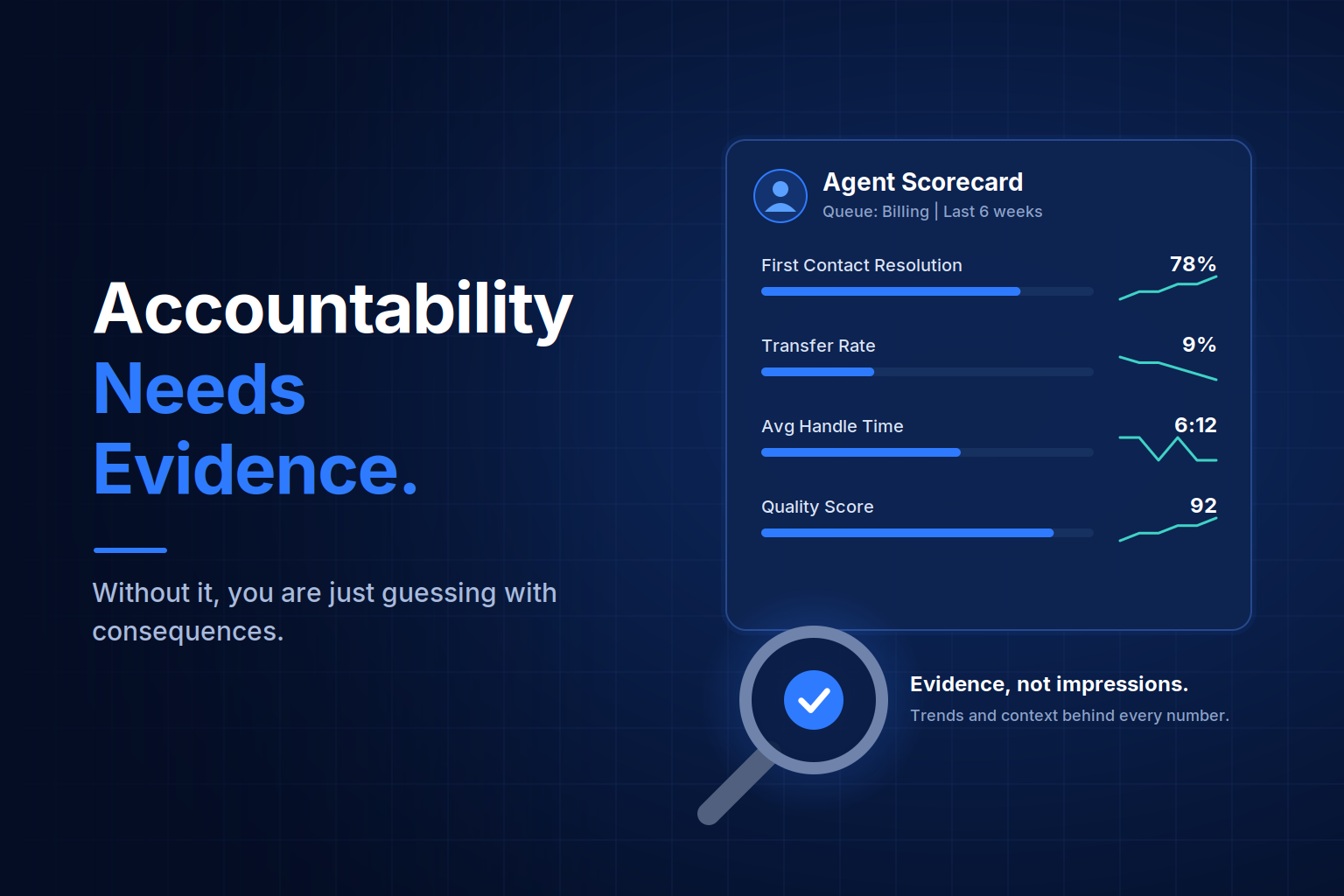
Accountability without evidence is not really accountability. It is guessing with consequences.
What the Evidence Gap Looks Like
Coaching Based on Anecdotes
When supervisors do not have easy access to individual performance data, coaching drifts toward whatever stood out recently. The agent who had one bad call gets attention. The agent whose transfer rate has crept up for six weeks does not, because nobody saw it.
Leaders Defending Numbers They Cannot Explain
A director is asked why service level fell last month. The honest answer is that they are not sure, and finding out would take a report request and a few days of waiting. So they offer a reasonable explanation that may or may not be true. Leadership accepts it, or does not, and either way the real cause stays hidden.
Agents Who Do Not Trust the Scorecard
If agents only see their metrics in a monthly review, and those metrics lack context, the scorecard feels like a verdict rather than a tool. Agents who handle the hardest queue look worse on handle time than agents who handle simple ones. Without that context, the numbers feel unfair, and people stop trying to move them.
Why It Happens
The data almost always exists. Your contact center platform records every interaction. The gap is in access and presentation. Reports take too long to get. Definitions differ between reports. The people who need the information most, the supervisors and managers making decisions every day, are often the furthest from it.
When evidence is hard to reach, people fall back on judgment. That is not a character flaw. It is a rational response to friction. The fix is reducing the friction, not asking people to try harder.
What Evidence-Based Accountability Looks Like
Shared Definitions
Everyone uses the same calculation for the same metric. When a supervisor and a director talk about service level, they are talking about the same number from the same source.
Visibility at Every Level
Agents can see their own performance as it happens, not weeks later. Supervisors can see trends across their team without waiting on a report. Leaders can drill from a summary number down to the queues, intervals, and people behind it.
Context Alongside the Number
Handle time is shown alongside the queue and contact type. Service level is shown alongside volume and staffing. A number without context invites the wrong conclusion.
Trends Over Snapshots
One bad day is noise. Six weeks of drift is a signal. Accountability that looks at trends is both fairer to people and more useful to the operation.
Building this kind of environment is less about tools than habits, though the tools make the habits possible. We wrote more about that in Building an Analytics-First Culture in Your Contact Center.
Frequently Asked Questions
How do you hold contact center agents accountable fairly? Give them visibility into their own metrics as they happen, and show those metrics with context like queue and contact type. Coach on trends rather than single incidents.
Why do contact center leaders struggle to explain performance changes? Usually because getting from a summary number to the underlying cause requires a report request and a wait. Self-service drill-down access closes that gap.
What is the first step toward evidence-based accountability? Agree on definitions for your core metrics and make sure everyone pulls them from the same source. Consistency has to come before anything else.
Do you need a new platform to get this visibility? No. Brightmetrics sits on top of Genesys Cloud, Mitel, and RingCentral and gives agents, supervisors, and leaders access to the same data at the level of detail each of them needs.
The Bottom Line
Contact centers do not have a data problem. They have an evidence problem. The numbers exist, but they do not reach the people making decisions quickly enough or clearly enough to change what happens next.
When evidence is easy to reach, accountability becomes something people can act on instead of something that happens to them. See how Brightmetrics puts that evidence in front of the people who need it.